Certified Pillar 3 Expert - Basel 3 (CP3E-B3), distance learning and online certification program
Overview
Pillar 3 of the Basel iii framework seeks to promote market discipline through regulatory disclosure requirements. Managers and employees with Basel iii Pillar 3 skills are necessary for the implementation of Basel iii around the world.
Objectives
The program has been designed to provide with the knowledge and skills needed to understand the third Pillar of the Basel III framework as amended in March 2017 (Basel Committee, March 2017, Pillar 3 disclosure requirements, consolidated and enhanced framework), and to work in Basel III Pillar 3 projects. The course provides with the skills needed to pass the Certified Pillar 3 Expert - Basel 3 (CP3-B3) exam.
Target Audience
This course is intended for managers and employees working in banks, financial organizations, financial groups, and financial conglomerates. It is also intended for management consultants, vendors, suppliers, and service providers working for financial organizations.
This course is highly recommended for:
- Managers and professionals involved in Basel III (decision making and implementation),
- Risk and compliance officers,
- Auditors,
- IT professionals,
- Analysts.
Course Synopsis
Introduction to the 3rd Pillar of Basel III.
- Information asymmetry.
- Moral hazard.
- Market discipline.
- The revised disclosure regime.
- The “hierarchy” of disclosures.
Basel Committee, March 2017 Amendment.
- Pillar 3 disclosure requirements, consolidated and enhanced framework.
- The “fixed” and the “flexible” format.
- Important templates.
- Template KM1: Key metrics (at consolidated group level).
- Template KM2: Key metrics – TLAC requirements (at resolution group level).
- Template OV1: Overview of RWA.
- Template PV1: Prudent valuation adjustments (PVA).
- Template CC1: Composition of regulatory capital.
- Template CC2 – Reconciliation of regulatory capital to balance sheet.
- Table CCA: Main features of regulatory capital instruments and of other TLAC-eligible instruments.
- Template TLAC1: TLAC composition for G-SIBs (at resolution group level).
- Template GSIB1 – Disclosure of G-SIB indicators.
- Template CCyB1 – Geographical distribution of credit exposures used in the countercyclical capital buffer.
- Template LR1 – Summary comparison of accounting assets vs leverage ratio exposure measure (January 2014 standard).
- Template LR2: Leverage ratio common disclosure template (January 2014 standard).
- Table LIQA – Liquidity risk management.
- Template LIQ1: Liquidity Coverage Ratio (LCR).
- Template LIQ2: Net Stable Funding Ratio (NSFR).
- Table CRA: General qualitative information about credit risk.
- Template CR1: Credit quality of assets.
- Template CR2: Changes in stock of defaulted loans and debt securities.
- Table CRB: Additional disclosure related to the credit quality of assets.
- Table CCRA: Qualitative disclosure related to counterparty credit risk.
- Template CCR1: Analysis of counterparty credit risk (CCR) exposure by approach.
- Template CCR2: Credit valuation adjustment (CVA) capital charge.
- Template CCR3: Standardised approach – CCR exposures by regulatory portfolio and risk weights.
- Table SECA: Qualitative disclosure requirements related to securitisation exposures.
- Template SEC1: Securitisation exposures in the banking book.
- Template SEC2: Securitisation exposures in the trading book.
- Template SEC3: Securitisation exposures in the banking book and associated regulatory capital requirements – bank acting as originator or as sponsor.
- Template SEC4: Securitisation exposures in the banking book and associated capital requirements – bank acting as investor.
- Table MRA: General qualitative disclosure requirements related to market risk.
- Template MR1: Market risk under the SA.
- Table REMA: Remuneration policy.
- Template REM1: Remuneration awarded during the financial year.
- Template REM2: Special payments.
- Template REM3: Deferred remuneration.
Become a Certified Pillar 3 Expert - Basel 3 (CP3E-B3)
We will send the program up to 24 hours after the payment. Please remember to check the spam folder of your email client too, as emails with attachments are often landed in the spam folder.
You have the option to ask for a full refund up to 60 days after the payment. If you do not want one of our programs or services for any reason, all you must do is to send us an email, and we will refund the payment, no questions asked.
Your payment will be received by our strategic partner and service provider, Cyber Risk GmbH (Dammstrasse 16, 8810 Horgen, Switzerland, Handelsregister des Kantons Zürich, Firmennummer: CHE-244.099.341). Cyber Risk GmbH may also send certificates to all members.
The all-inclusive cost is $297. There is no additional cost, now or in the future, for this program.
First option: You can purchase the Certified Pillar 3 Expert - Basel 3 (CP3E-B3) program with VISA, MASTERCARD, AMEX, Apple Pay, Google Pay etc.
Purchase the CP3E-B3 program here (VISA, MASTERCARD, AMEX, Apple Pay, Google Pay etc.)
Second option: QR code payment.
i. Open the camera app or the QR app on your phone.
ii. Scan the QR code and possibly wait for a few seconds.
iii. Click on the link that appears, open your browser, and make the payment.

Third option: You can purchase the Certified Pillar 3 Expert - Basel 3 (CP3E-B3) program with PayPal
When you click "PayPal" below, you will be redirected to the PayPal web site. If you prefer to pay with a card, you can click "Debit or Credit Card" that is also powered by PayPal.
What is included in the price:
A. The official presentations (261 slides)
The presentations are effective and appropriate to study online or offline. Busy professionals have full control over their own learning and are able to study at their own speed. They are able to move faster through areas of the course they feel comfortable with, but slower through those that they need a little more time on.
B. Up to 3 online exam attempts per year
Candidates must pass only one exam to become CP3E-B3s. If they fail, they must study the official presentations and retake the exam. Candidates are entitled to 3 exam attempts every year.
If candidates do not achieve a passing score on the exam the first time, they can retake the exam a second time.
If they do not achieve a passing score the second time, they can retake the exam a third time.
If candidates do not achieve a passing score the third time, they must wait at least one year before retaking the exam. There is no additional cost for any additional exam attempts.
To learn more, you may visit:
https://www.basel-iii-association.com/Questions_About_The_Certification_And_The_Exams_1.pdf
https://www.basel-iii-association.com/Certification_Steps_CP3E_B3.pdf
C. The Certificate, with a scannable QR code for verification.
You will receive your certificate via email in Adobe Acrobat format (pdf), with a scannable QR code for verification, 7 business days after you pass the exam. A business day refers to any day in which normal business operations are conducted (in our case Monday through Friday), excluding weekends and public holidays.
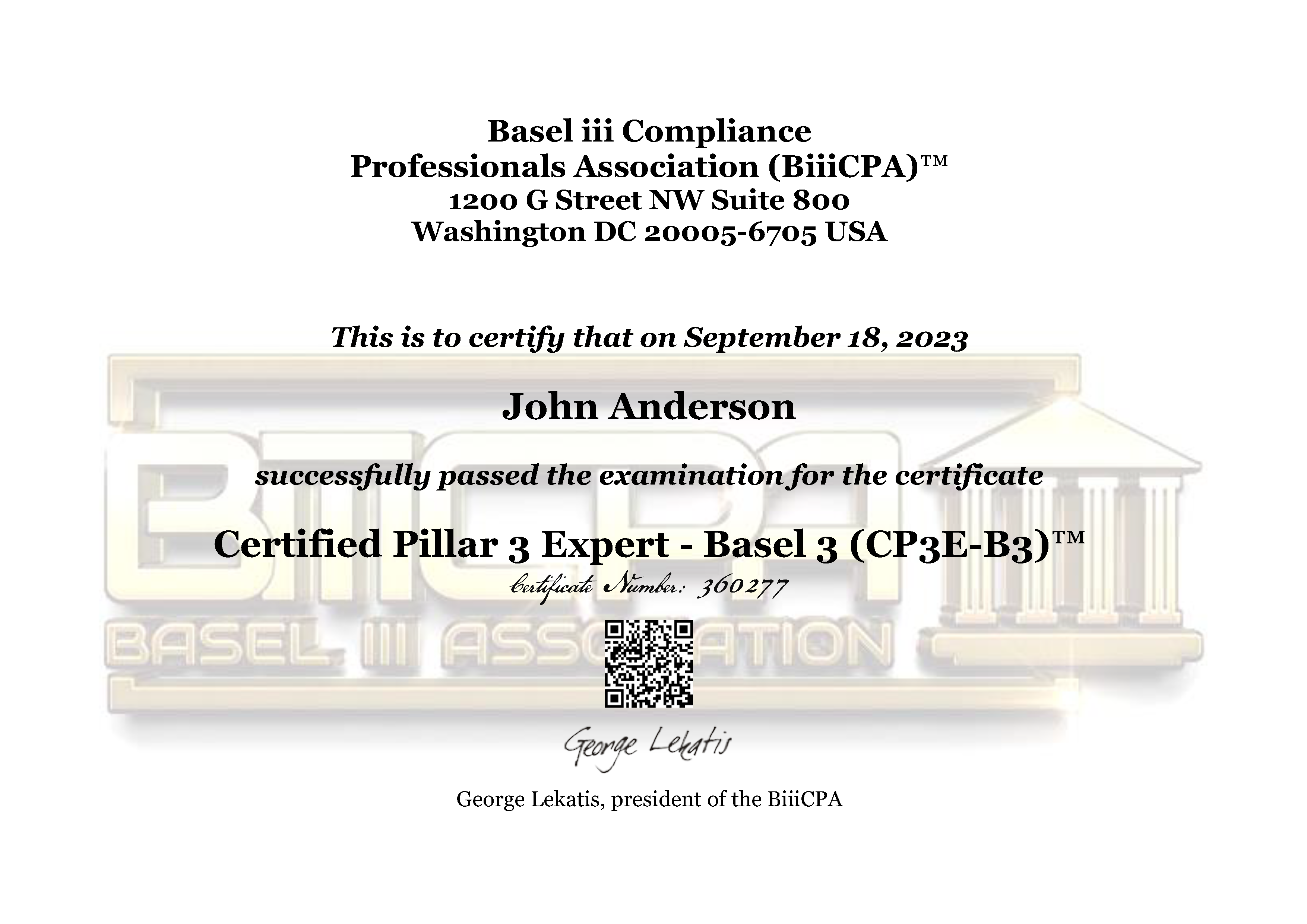
D. One web page of the Basel iii Compliance Professionals Association (BiiiCPA) dedicated to you (https://www.basel-iii-association.com/Your_Name.htm).
When third parties scan the QR code on your certificate, they will visit the web page of the Basel iii Compliance Professionals Association (BiiiCPA) that is dedicated to you. They will be able to verify that you are a certified professional, and your certificates are valid and legitimate.
In this dedicated web page we will have your name, the certificates you have received from us, pictures of your certificates, and a picture of your lifetime membership certificate if you are a lifetime member.
This is an example:
https://www.basel-iii-association.com/John_Anderson.htm
Professional certificates are some of the most frequently falsified documents. Employers and third parties need an easy, effective, and efficient way to check the authenticity of each certificate. QR code verification is a good response to this demand.
Frequently Asked Questions
1. I want to learn more about the Basel iii Compliance Professionals Association (BiiiCPA).
The Basel iii Compliance Professionals Association (BiiiCPA) is the largest association of Basel iii Professionals in the world. It is a business unit of the Basel ii Compliance Professionals Association (BCPA), the largest association of Basel ii Professionals in the world.
The BiiiCPA is a global community of experts working in risk and compliance management, that explore career avenues, and acquire lifelong skills.
Both associations are wholly owned by Compliance LLC, a company incorporated in Wilmington, NC, and offices in Washington, DC, a provider of risk and compliance training and executive coaching in 57 countries.
Several business units of Compliance LLC are very successful associations that offer standard, premium and lifetime membership, weekly or monthly updates, training, certification, Authorized Certified Trainer (ACT) programs, interest representation, and other services to their members. The business units of Compliance LLC include:
- The Sarbanes-Oxley Compliance Professionals Association (SOXCPA), the largest Association of Sarbanes-Oxley professionals in the world. You may visit: https://www.sarbanes-oxley-association.com
- The Solvency II Association, the largest association of Solvency II professionals in the world. You may visit: https://www.solvency-ii-association.com
- The International Association of Risk and Compliance Professionals (IARCP). You may visit: https://www.risk-compliance-association.com
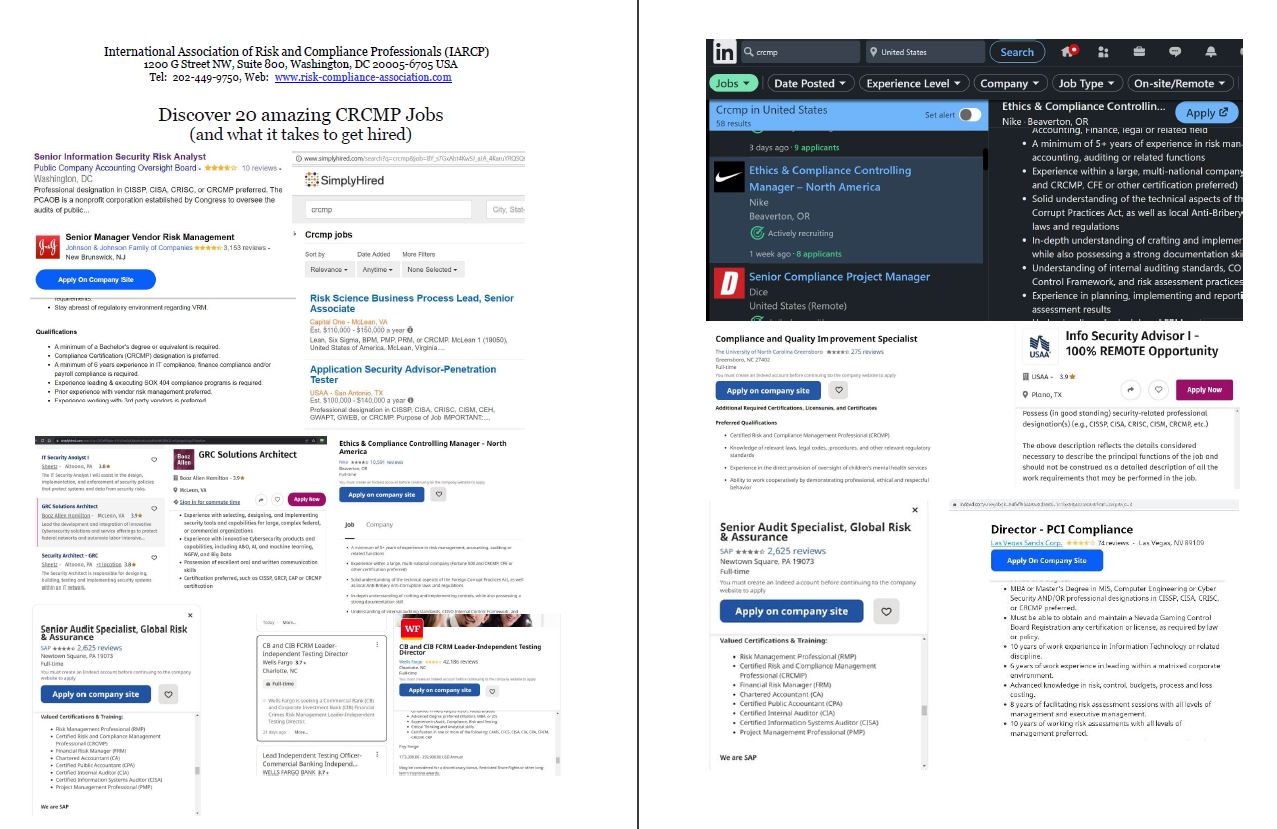
The Certified Risk and Compliance Management Professional (CRCMP) certificate, from the IARCP, has become one of the most recognized certificates in risk management and compliance. There are CRCMPs in 57 countries. Companies and organizations around the world consider the CRCMP a preferred certificate.
You can find more about the demand for CRCMPs at: https://www.risk-compliance-association.com/CRCMP_Jobs_Careers.pdf
2. Does the association offer training?
The BiiiCPA offers distance learning and online certification programs in most countries, and in-house instructor-led training programs in companies and organizations in many countries.
A. Distance learning and online certification programs.
- Certified Basel iii Professional (CBiiiPro). To learn more, you may visit: https://www.basel-iii-association.com/Basel_III_Distance_Learning_Online_Certification.html
- Certified Pillar 3 Expert - Basel 3 (CP3E-B3). To learn more, you may visit: https://www.basel-iii-association.com/CP3E_B3_Distance_Learning_Online_Certification.html
- Certified Stress Testing Expert - Basel 3 (CSTE-B3). To learn more, you may visit: https://www.basel-iii-association.com/CSTE_B3_Distance_Learning_Online_Certification.html
B. Instructor-led training.
The association develops and maintains three certification programs and many tailor-made training programs for directors, executive managers, risk and compliance managers, internal and external auditors, data owners, process owners, consultants, suppliers, and service providers.
For instructor-led training, you may contact Lyn Spooner at: lyn@basel-iii-association.com
3. Is there any discount available for the distance learning programs?
We do not offer a discount for your first program, as we want to keep the cost as low as possible for all members. You have a $100 discount for your second and each additional program.
For example, after you purchase the Certified Basel iii Professional (CBiiiPro) program at $297, you can purchase:
- The Certified Pillar 3 Expert - Basel 3 (CP3E-B3) program at $197 (instead of $297).
- The Certified Stress Testing Expert - Basel 3 (CSTE-B3) program at $197 (instead of $297).
- The Certified Risk and Compliance Management Professional (CRCMP) program at $197 (instead of $297),
- The Certified Information Systems Risk and Compliance Professional (CISRCP) program at $197 (instead of $297),
- The Certified Cyber (Governance Risk and Compliance) Professional - CC(GRC)P program at $197 (instead of $297),
- The Certified Risk and Compliance Management Professional in Insurance and Reinsurance - CRCMP(Re)I program at $197 (instead of $297),
To find more about programs 3 to 6 above, you may visit the International Association of Risk and Compliance Professionals (IARCP) at: https://www.risk-compliance-association.com/Distance_Learning_and_Certification.htm
Lifetime members can purchase each of the distance learning and online certification programs at $148, instead of $297.
If you are a lifetime member, or you have already purchased one of our programs and you want to purchase your next discounted program, you can contact Lyn Spooner via email to receive the URL for the discounter price (at lyn@basel-iii-association.com).
4. Are your training and certification programs vendor neutral?
Yes. We do not promote any products or services, and we are 100% independent.
5. Are there any entry requirements or prerequisites required for enrolling in the training programs?
There are no entry requirements or prerequisites for enrollment. Our programs give the opportunity to individuals of all levels to learn, grow, and develop new skills without the need for prior qualifications or specific experience.
6. I want to learn more about the exam.
You can take the exam online from your home or office, in all countries.
It is an open book exam. Risk and compliance management is something you must understand and learn, not memorize. You must acquire knowledge and skills, not commit something to memory.
You will be given 90 minutes to complete a 35-question exam. You must score 70% or higher.
The exam contains only questions that have been clearly answered in the official presentations.
All exam questions are multiple-choice, composed of two parts:
a. A stem (a question asked, or an incomplete statement to be completed).
b. Four possible responses.
In multiple-choice questions, you must not look for a correct answer, you must look for the best answer. Cross out all the answers you know are incorrect, then focus on the remaining ones. Which is the best answer? With this approach, you save time, and you greatly increase the likelihood of selecting the correct answer.
TIME LIMIT - This exam has a 90-minute time limit. You must complete this exam within this time limit, otherwise the result will be marked as an unsuccessful attempt.
BACK BUTTON - When taking this exam you are NOT permitted to move backwards to review/change prior answers. Your browser back button will refresh the current page instead of moving backward.
RESTART/RESUME – You CANNOT stop and then resume the exam. If you stop taking this exam by closing your browser, your answers will be lost, and the result will be marked as an unsuccessful attempt.
SKIP - You CANNOT skip answering questions while taking this exam. You must answer all the questions in the order the questions are presented.
We do not send sample questions or past exams. If you study the presentations, you can score 100%.
When you are ready to take the CBiiiPro exam, you must follow the steps: https://www.basel-iii-association.com/Certification_Steps_CBiiiPro.pdf When you are ready to take the CP3E-B3 exam, you must the steps: https://www.basel-iii-association.com/Certification_Steps_CP3E_B3.pdf When you are ready to take the CSTE-B3 exam, you must follow the steps: https://www.basel-iii-association.com/Certification_Steps_CSTE_B3.pdf7. How comprehensive are the presentations? Are they just bullet points?
The presentations are not bullet points. They are effective and appropriate to study online or offline.
8. Do I need to buy books to pass the exam?
No. If you study the presentations, you can pass the exam. All the exam questions are clearly answered in the presentations. If you fail the first time, you must study more. Print the presentations and use Post-it to attach notes, to know where to find the answer to a question.
9. Is it an open book exam? Why?
Yes, it is an open book exam. Risk and compliance management is something you must understand and learn, not memorize. You must acquire knowledge and skills, not commit something to memory.
10. Do I have to take the exam soon after receiving the presentations?
No. You can take the exam any time. Your account never expires. You have lifetime access to the training program. If there are any updates to the training material, the updated program will be sent free of charge.
11. Do I have to spend more money in the future to remain certified?
No. Your certificate never expires. It will be valid, without the need to spend money or to take another exam in the future.
12. Ok, the certificate never expires, but things change.
Recertification would be a great recurring revenue stream for the association, but it would also be a recurring expense for our members. We resisted the temptation to "introduce multiple recurring revenue streams to keep business flowing", as we were consulted. No recertification is needed for our programs.
Things change, and this is the reason you need to become (at no cost) a member of the association. Every month you can visit the "Reading Room" of the association and read our newsletter with updates, alerts, and opportunities, to stay current.
13. How many hours do I need to study to pass the exam?
You must study the presentations at least twice, to ensure you have learned the details. The average time needed is:
- 42 hours for the CBiiiPro program,
- 17 hours for the CP3E-B3 program,
- 33 hours for the CSTE-B3 program.
This is the average time needed. There are important differences among members.
14. I want to receive a printed certificate. Can you send me one?
Unfortunately this is not possible. You will receive your certificate via email in Adobe Acrobat format (pdf), with a scannable QR code for verification, 7 business days after you pass the exam. A business day refers to any day in which normal business operations are conducted (in our case Monday through Friday), excluding weekends and public holidays.
The association will develop a dedicated web page for each certified professional (https://www.basel-iii-association.com/Your_Name.html). In your dedicated web page we will add your full name, all the certificates you have received from the association, and the pictures of your certificates.
When third parties scan the QR code on your certificate, they will visit your dedicated web page, and they will be able to verify that you are a certified professional, and your certificates are valid and legitimate.
Professional certificates are some of the most frequently falsified documents. Employers and third parties need an easy, effective, and efficient way to check the authenticity of each certificate. QR code verification is a good response to this demand.
You can print your certificate that you will receive in Adobe Acrobat format (pdf). With the scannable QR code, all third parties can verify the authenticity of each certificate in a matter of seconds.
15. Which is the refund policy?
The association has a very clear refund policy: You have the option to ask for a full refund up to 60 days after the payment. If you do not want one of our programs or services for any reason, all you must do is to send us an email, and we will refund the payment after one business day, no questions asked.
16. Why should I get certified, and why should I choose your certification programs?
- The Basel iii Compliance Professionals Association (BiiiCPA) is the largest association of Basel iii Professionals in the world. It is a business unit of the Basel ii Compliance Professionals Association (BCPA), the largest association of Basel ii Professionals in the world.
- Our training programs are flexible and convenient. Learners can access the course material and take the exam at any time and from any location. This is especially important for those with busy schedules.
- The all-inclusive cost of our programs is very low. There is no additional cost for each program, now or in the future, for any reason.
- If you purchase a second program, you have a $100 discount. The all-inclusive cost for your second (and each additional) program is $197.
- There are 3 exam attempts per year that are included in the cost of each program, so you do not have to spend money again if you fail.
- No recertification is required. Your certificates never expire.
- The marketplace is clearly demanding qualified professionals in risk and compliance management. Certified professionals enjoy industry recognition and have more and better job opportunities. It is important to get certified and to belong to professional associations. You prove that you are somebody who cares, learns, and belongs to a global community of professionals.
- Firms and organizations hire and promote fit and proper professionals who can provide evidence that they are qualified. Employers need assurance that managers and employees have the knowledge and skills needed to mitigate risks and accept responsibility. Supervisors and auditors ask for independent evidence that the process owners are qualified, and that the controls can operate as designed, because the persons responsible for these controls have the necessary knowledge and experience.
- Professionals that gain more skills and qualifications often become eligible for higher-paying roles. Investing in training can have a direct positive impact on a manager's or employee's earning potential.
BiiiCPA, some of our clients